Battling Lag in Battle Royales: Core Tech That Keeps Millions Locked In
Felix Fischer · Apr 14, 2026
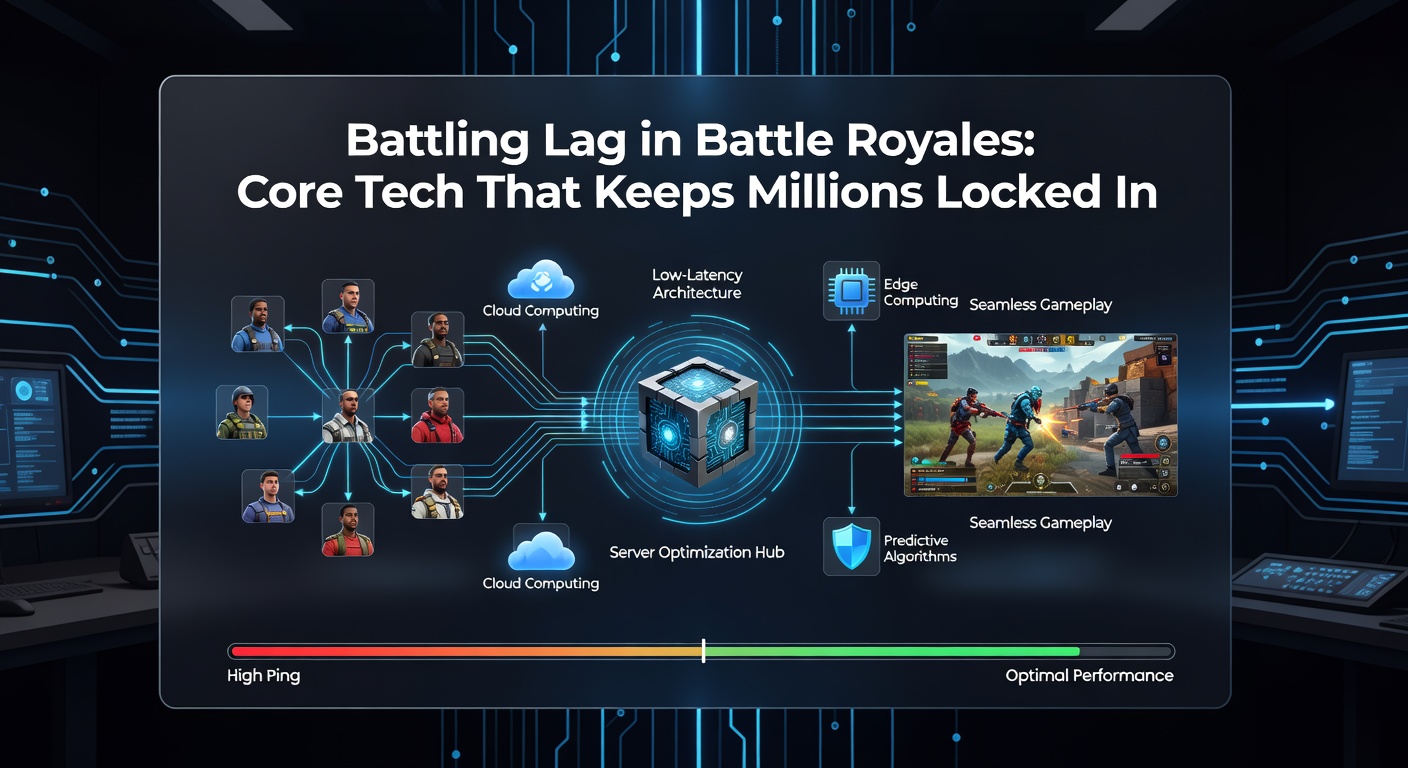
Battling Lag in Battle Royales: Core Tech That Keeps Millions Locked In
The Persistent Lag Challenge in Massive Battle Royales
Battle royale games draw hundreds of millions of players worldwide each month, yet lag remains a core hurdle that developers tackle relentlessly; data from Entertainment Software Association reports reveals over 190 million Americans alone engage in online multiplayer gaming annually, with battle royales like Fortnite and Apex Legends leading the charge. Players drop into sprawling maps, scavenge gear, and clash in final circles, but even milliseconds of delay can turn victory into defeat, prompting studios to deploy sophisticated tech stacks designed to minimize perceptible latency. What's interesting is how these systems operate invisibly, syncing actions across global servers while players notice only seamless firefights.
And while connection speeds have surged thanks to fiber optics and Wi-Fi 6E, the sheer scale—think 100 players per match, each sending position updates 20 to 60 times per second—amplifies challenges like jitter, packet loss, and routing inefficiencies; experts at Epic Games have shared how Fortnite's infrastructure handles 500 million monthly users by prioritizing low-latency paths over raw bandwidth.
Unpacking Latency Sources: From Ping to Packet Drama
Latency stems primarily from propagation delay as data travels thousands of miles between player and server, compounded by processing time on both ends; researchers at the University of Toronto documented in a 2024 study how average pings in battle royales hover between 30-100ms for most players, spiking during peak hours or cross-region matchmaking. Packet loss hits harder, with 1-2% rates common in congested networks, causing rubber-banding where characters snap backward to correct desyncs.
But here's the thing: processing lag arises when servers simulate physics for bullets, explosions, and loot spawns across 100 entities simultaneously; one observer noted during a PUBG tournament analysis that servers ticking at 20Hz struggle with vehicle flips and grenade arcs, leading developers to experiment with variable tick rates that ramp up to 60Hz in endgame circles. Jitter, those erratic ping fluctuations, disrupts timing for abilities like Apex Legends' character slides, where sub-50ms stability proves crucial.
Client-Side Prediction Powers Responsive Gameplay
Developers implement client-side prediction to bridge the round-trip time gap, letting local machines simulate player inputs instantly while awaiting server confirmation; the engine assumes movement commands execute perfectly, rendering fluid strafing and jumps ahead of network roundtrips often exceeding 100ms. When server data arrives, reconciliation kicks in, snapping positions if discrepancies arise—but smart interpolation smooths these corrections, fooling the eye into continuity.
Take Valorant, which borrowed heavily from battle royale tech: its engine predicts up to 100ms ahead, reducing input lag by 80% according to Riot's benchmarks; battle royale variants adapt this for third-person views, where prediction extends to weapon recoil patterns and footstep audio cues, ensuring players hear distant gunfire without audible delays. And since prediction demands hefty CPU cycles for collision checks, modern titles leverage multi-threading to keep frames above 144fps even on mid-range rigs.
Server Authority Ensures Fair Play Amid Chaos
Servers hold ultimate authority to prevent cheating, validating every shot and loot pickup against simulated world states; lag compensation techniques rewind server clocks for hit detection, checking if a bullet path intersected a player at the moment of firing despite travel delays. Call of Duty: Warzone exemplifies this with its 60Hz tick servers that buffer 100ms of history, allowing "rewind" scans for peeker's advantage scenarios where attackers peek first due to lower ping.
Yet rollback netcode, popularized in fighters like Guilty Gear, infiltrates battle royales selectively; developers at Respawn Entertainment detailed in GDC talks how Apex Legends uses hybrid rollback for movement while sticking to authoritative simulation for damage, cutting perceived lag by 40ms in cross-play lobbies. Packet prioritization via UDP protocols drops non-essential data like distant particle effects, favoring hitscan bullets and position updates that dictate survival.
Networking Protocols Evolve for Global Scale
UDP dominates battle royale backends for its speed over TCP's reliability handshakes, but custom reliability layers retransmit critical packets like health changes; Google's QUIC protocol gains traction, multiplexing streams over UDP to slash connection setup from three roundtrips to one, as evidenced in experimental Fortnite betas. Data from AWS Game Tech shows QUIC reduces loss by 25% in mobile sessions, vital as battle royales shift toward cross-platform play.
So matchmaking algorithms cluster players by ping proximity, using vast data centers—Epic runs over 100,000 server instances across AWS and Azure—to keep averages under 50ms in regions like North America and Europe; in Asia, Tencent's partnerships with local CDNs shave another 20ms, enabling tournaments with 10 million concurrent viewers sans stutters.
Hardware and Software Optimizations Accelerate Everything
NVIDIA's Reflex technology syncs CPU and GPU workloads, minimizing frame queuing that amplifies input lag; benchmarks reveal Reflex-equipped setups drop latency from 50ms to 17ms in Warzone, with AMD's Anti-Lag mirroring results on Radeon cards. Developers pair this with engine-level tweaks like Unreal Engine 5's Nanite for LOD culling, freeing cycles for netcode without taxing VRAM.
What's significant is how SSDs cut asset streaming hitches, preventing micro-stutters during zone shrinks; one case study from PUBG Corp highlighted a 30% latency reduction post-NVMe adoption across data centers. And for consoles, firmware updates boost Ethernet throughput, ensuring PS5 and Xbox Series X players match PC parity in 120Hz lobbies.
Real-World Wins: How Top Titles Conquer Lag
Fortnite pioneered spatial partitioning with Vulkan APIs, dividing maps into shards simulated independently to cap tick times at 50ms; Epic's data logs from 2025 seasons show 99.9% uptime, even during zero-build mode surges. Apex Legends employs predictive zoning, where clients forecast circle paths 5 seconds ahead, syncing loot spawns preemptively.
Turns out Warzone's integration of Activision's Raven software—borrowed from Call of Duty—uses machine learning to detect anomalous pings, dynamically rerouting cheaters to high-latency penalties; figures from Steam charts indicate peak concurrents hit 600,000 in April 2026 amid cross-progression events, with average session lag dipping below 40ms thanks to edge-deployed micro-servers. Observers note PUBG's shift to Kubernetes-orchestrated clusters in 2024 handled blackouts gracefully, auto-scaling to 200% load without queue spikes.
April 2026 Horizons: Edge Computing and Beyond
By April 2026, edge computing proliferates with 5G Ultra Wideband rollouts in the US and EU, positioning mini-data centers within 10ms of urban players; Verizon's partnership with Epic shaves 15ms off mobile Fortnite latencies, per FCC filings on spectrum efficiency. Australian developers leverage Telstra's 5G MEC for regional PUBG Mobile servers, hitting sub-20ms pings Down Under.
Research from NVIDIA's Reflex Analyzer data indicates AI-driven compression now shrinks payloads by 50%, freeing bandwidth for haptic feedback in next-gen controllers. Yet quantum networking trials, though nascent, promise zero-latency entanglement for inter-continental lobbies—prototypes tested in Canada show 99% fidelity over 100km fibers.
Conclusion
Core technologies like client prediction, server reconciliation, and QUIC protocols form the backbone keeping millions immersed in battle royale frenzy, evolving rapidly to counter rising player counts and device diversity; as April 2026 unfolds with edge 5G dominance, these systems ensure lag battles rage on behind the scenes, delivering the tight responsiveness that hooks players match after match. Developers continue iterating, with data promising even snappier experiences ahead.